Thanksgiving Poems for Kids: Funny Poems, Writing Activities & Prompts
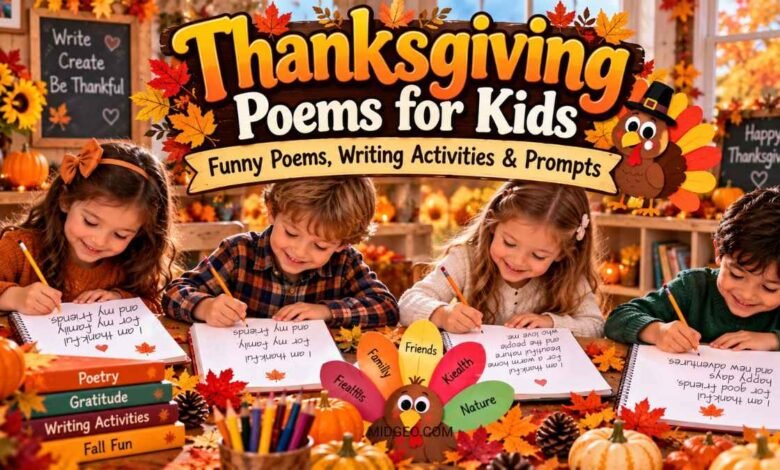
Thanksgiving is a wonderful time to celebrate gratitude, family, friendship, and all the little things that make life special. Whether you’re a parent looking for a fun holiday activity, a teacher planning a classroom lesson, or a church leader preparing a Thanksgiving program, Thanksgiving poems for kids are a beautiful way to bring the spirit of the holiday to life.
From silly turkey rhymes and funny Thanksgiving poems to heartfelt verses about family and faith, poetry gives children a creative way to express what they are thankful for. You can also make the holiday more meaningful with Thanksgiving writing activities, gratitude journals, and simple writing prompts that encourage kids to think about the people and experiences they appreciate.
In this collection, you’ll discover original Thanksgiving poems for kids, preschoolers, families, and church gatherings, along with easy writing activities and prompts for different ages. These ideas are perfect for classrooms, homeschool lessons, family dinners, Sunday school, and cozy November afternoons.
1. Thanksgiving Poems for Kids
Thanksgiving poems help children explore gratitude while practicing reading, vocabulary, rhyming, and creative writing. Short poems with familiar holiday images—like pumpkins, turkeys, autumn leaves, and family dinners—are especially fun for young readers.
Here are three original Thanksgiving poems children can read, memorize, illustrate, or share with their families.
A Thankful Little Heart
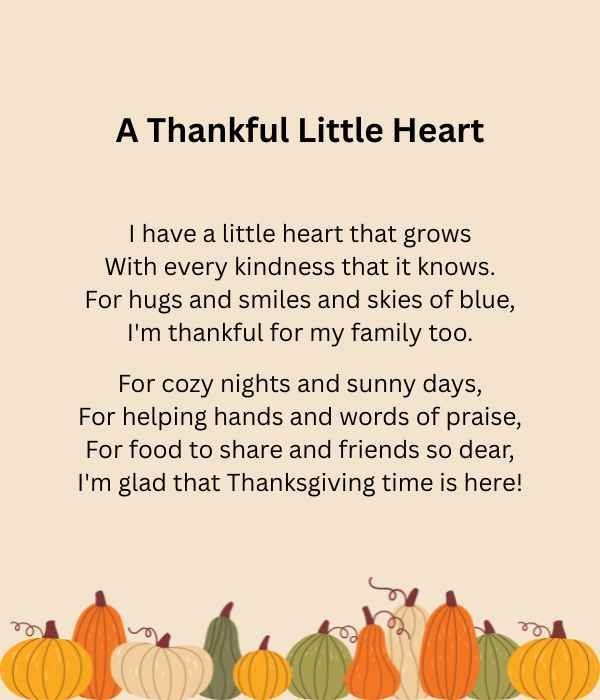
I have a little heart that grows
With every kindness that it knows.
For hugs and smiles and skies of blue,
I’m thankful for my family too.
For cozy nights and sunny days,
For helping hands and words of praise,
For food to share and friends so dear,
I’m glad that Thanksgiving time is here!
Thanksgiving Day
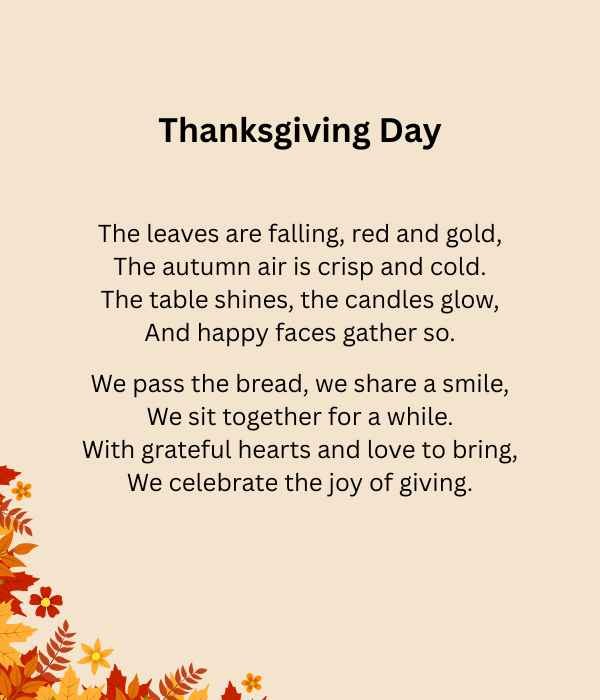
The leaves are falling, red and gold,
The autumn air is crisp and cold.
The table shines, the candles glow,
And happy faces gather so.
We pass the bread, we share a smile,
We sit together for a while.
With grateful hearts and love to bring,
We celebrate the joy of giving.
My Thankful List
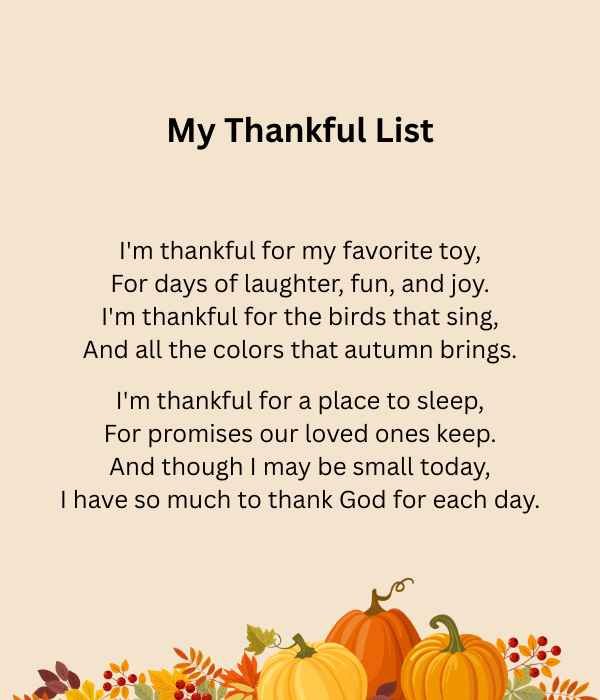
I’m thankful for my favorite toy,
For days of laughter, fun, and joy.
I’m thankful for the birds that sing,
And all the colors that autumn brings.
I’m thankful for a place to sleep,
For promises our loved ones keep.
And though I may be small today,
I have so much to thank God for each day.
Activity idea: Ask children to choose their favorite poem and draw a picture showing what the poem means to them. They can also circle the rhyming words or read the poem aloud to a partner.
Related: 19 Traditional Thanksgiving Tablescapes for a Classic Holiday Look
2. Funny Thanksgiving Poems
Funny Thanksgiving poems are perfect for getting kids excited about reading and writing. Silly turkeys, runaway pies, messy dinner tables, and mischievous pumpkins can turn poetry into a holiday game.
These original poems work well for classroom performances, Thanksgiving parties, and family gatherings.
The Silly Thanksgiving Turkey
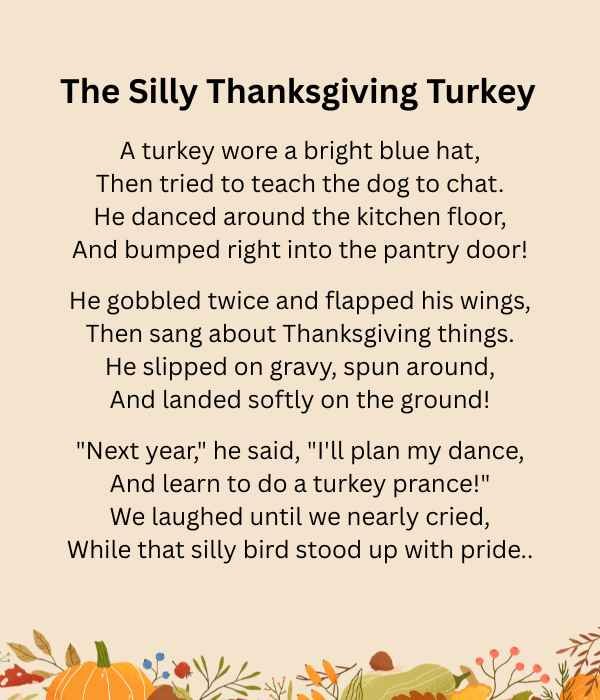
A turkey wore a bright blue hat,
Then tried to teach the dog to chat.
He danced around the kitchen floor,
And bumped right into the pantry door!
He gobbled twice and flapped his wings,
Then sang about Thanksgiving things.
He slipped on gravy, spun around,
And landed softly on the ground!
“Next year,” he said, “I’ll plan my dance,
And learn to do a turkey prance!”
We laughed until we nearly cried,
While that silly bird stood up with pride.
The Runaway Pumpkin Pie
Our pumpkin pie jumped off the plate,
And hurried through the garden gate.
It rolled past Grandma’s favorite tree,
Then shouted, “Come and chase me!”
It bounced right past the pumpkin patch,
Too quick for Grandpa’s little catch.
At last it stopped beside a chair,
And left a crumb trail everywhere!
We found our pie and laughed with glee,
A sweeter mess you’ll never see.
Next year we’ll keep it safe inside,
Before our pie decides to slide!
The Turkey Who Hated Gobbling
A turkey said, “I will not gobble!
That sound is silly, loud, and wobbly.
I’d rather whistle, hum, or sing,
Or learn to play the violin!”
He practiced songs from morning till night,
And sang each note with all his might.
But when he tried a fancy tune,
He gobbled louder than a loon!
“Perhaps,” he said, “I’ll keep my sound.
A better gobble can’t be found!”
Then off he went with a happy grin,
To start his turkey band again.
Funny poem activity: Invite children to invent their own silly Thanksgiving character. It could be a dancing turkey, a talking pumpkin, a pie that runs away, or a turkey who wants to become a chef. Ask them to write four to eight rhyming lines about their character’s funniest adventure.
Related: 25+ DIY Thanksgiving Decorations Ideas to Create a Warm & Welcoming Home
3. Thanksgiving Poems for Preschoolers
Preschoolers enjoy poems that are short, repetitive, and easy to remember. Simple rhymes help little learners develop listening skills, recognize patterns, and practice new words.
Use gestures, picture cards, finger movements, or small toy turkeys to make these poems more engaging.
Little Turkey
Little turkey, feathers bright,
Wiggle left and wiggle right.
Flap your wings and stamp your feet,
Thanksgiving time is such a treat!
Five Little Pumpkins
Five little pumpkins by the door,
One rolled away, and then there were four.
Four little pumpkins beneath a tree,
One went rolling, leaving three.
Three little pumpkins, orange and round,
One rolled gently across the ground.
Two little pumpkins beneath the sky,
One rolled away as clouds drifted by.
One little pumpkin left to stay,
Happy Thanksgiving is here today!
Thank You, Thank You
Thank you for my food today,
Thank you for my games to play.
Thank you for my friends so dear,
Thank you for the love that’s here.
Thank you for the sun above,
Thank you for a home filled with love.
Clap your hands and shout with cheer,
Thanksgiving time is finally here!
Preschool Thanksgiving Poetry Activities
- Turkey feather gratitude: Give each child a paper turkey and let them name one thing they are thankful for on each paper feather.
- Act out the poem: Have children flap their arms, wiggle, clap, or march as they recite the verses.
- Picture-and-word matching: Match simple pictures of food, family, toys, and animals to words in a Thanksgiving poem.
- Finish the rhyme: Say, “I am thankful for my cat, who likes to wear a funny…” and invite children to complete the sentence.
- Make a class poetry wall: Display each child’s drawing alongside a short dictated sentence about gratitude.
Keep activities brief, playful, and flexible so children can participate even if they are not ready to write independently.
Related: 17 Teacher Thanksgiving Gifts Ideas to Show Heartfelt Gratitude
4. Thanksgiving Writing Activities for Kids
Thanksgiving writing activities help children connect the holiday with creativity, reflection, and language development. They are useful for teachers, parents, and homeschool families looking for meaningful November projects.
1. Create a Thanksgiving Gratitude Journal
Give each child a small notebook or a few stapled pages. Ask them to write or draw one thing they are thankful for each day during the week leading up to Thanksgiving.
Younger children can draw pictures while adults write down their spoken answers. Older children can add a sentence explaining why each item matters to them.
Example: “I am thankful for my best friend because she makes me laugh when I feel sad.”
2. Write a Thanksgiving Acrostic Poem
An acrostic poem uses the letters of a word to begin each line. Write THANKFUL vertically on a page and ask children to create a phrase for every letter.
For example:
T — Time with family
H — Helping one another
A — Autumn leaves
N — Nice things to share
K — Kindness every day
F — Friends who care
U — Understanding others
L — Love everywhere
Children can decorate their finished poems with leaves, turkeys, pumpkins, or colorful borders.
3. Make a Thankful Turkey
Draw or print a large turkey outline and cut out several paper feathers. On each feather, children write or draw something they appreciate.
Ideas include family members, pets, teachers, favorite books, warm clothes, playgrounds, or special memories.
Display the turkeys around the classroom or bring them to the Thanksgiving dinner table.
4. Write a Letter of Thanks
Encourage kids to write a short letter to someone who has helped them. It could be a grandparent, teacher, coach, neighbor, friend, or family member.
A simple structure can help:
- Dear ___,
- Thank you for ___.
- It made me feel ___.
- One thing I appreciate about you is ___.
- From, ___.
Children can decorate their letters and deliver them in person or by mail.
5. Create a Thanksgiving Storybook
Ask children to write a short story about a Thanksgiving adventure. They might imagine a turkey who gets lost, a family preparing a special meal, or a pumpkin that comes alive.
Have them create a cover, write the story, and illustrate each page. Children who are not yet writing can dictate their stories to an adult.
6. Write a Recipe Memory
Food is an important part of many Thanksgiving celebrations. Ask children to describe a favorite holiday dish or a meal they enjoy sharing with loved ones.
They can include the dish’s name, ingredients they know, who makes it, and why it is special.
This activity combines descriptive writing with family storytelling.
7. Make a Classroom Gratitude Chain
Give each child a strip of colored paper. Ask them to write one thing they are thankful for, then connect all the strips into a paper chain.
Read the messages aloud if children are comfortable sharing. Hang the finished chain in the classroom as a reminder that gratitude can bring people together.
5. Thanksgiving Writing Prompts for Kids
Writing prompts make it easier for children to begin writing when they are unsure what to say. Use these ideas for journal entries, short stories, poems, classroom warm-ups, or family conversations.
Gratitude Writing Prompts
- What are three things you are thankful for today?
- Who is someone that makes your life better, and why?
- Describe a time someone was kind to you.
- What is one thing you often take for granted?
- What does being thankful mean to you?
- Write about a place where you feel safe and happy.
- What is your favorite memory with your family?
- How can you show gratitude without buying a gift?
- What is one skill you are thankful to have learned?
- Describe a small thing that made you smile recently.
Funny Thanksgiving Writing Prompts
- What if a turkey came to school and became your teacher?
- Imagine a pumpkin pie that could talk. What would it say?
- What would happen if all the Thanksgiving food disappeared?
- Write a story about a turkey who wants to become a famous singer.
- What if your pet prepared the Thanksgiving dinner?
- Imagine a mashed potato mountain in your backyard.
- What would you do if your Thanksgiving leftovers came alive?
- Write a conversation between a turkey and a pumpkin.
- What if you could invent a brand-new Thanksgiving dessert?
- Describe the funniest thing that could happen during a family dinner.
Creative Thanksgiving Writing Prompts
- If you could invite anyone to Thanksgiving dinner, who would it be?
- Describe Thanksgiving through the eyes of a little turkey.
- Write about a magical autumn leaf that grants wishes.
- Imagine celebrating Thanksgiving in a treehouse.
- Create a new holiday tradition for your family.
- Write a poem about the colors, sounds, and smells of autumn.
- Describe your perfect Thanksgiving from morning until bedtime.
- What would you put in a gratitude treasure chest?
- Write a story about a lost pilgrim’s hat or a missing dinner roll.
- If you could spread one act of kindness throughout your town, what would it be?
Writing Prompts for Older Kids
- Why is gratitude important even when life is difficult?
- Can people show thankfulness through actions instead of words? Explain.
- How can a community help families who need support during the holidays?
- Compare a Thanksgiving celebration today with one from the past.
- Write a persuasive paragraph explaining why everyone should practice gratitude.
- Describe how traditions help families feel connected.
- What does it mean to share with others?
- How can people celebrate Thanksgiving respectfully while learning about its complex history?
- Write about a tradition you would like to preserve or change.
- Imagine a future Thanksgiving celebration 100 years from now.
Tip for teachers and parents: Choose prompts that fit each child’s age and writing ability. Preschoolers may answer through drawings or dictation, while older children can write complete paragraphs or develop longer stories.
6. Thanksgiving Poems for Family
Family gatherings are a wonderful opportunity to share poetry. A short Thanksgiving poem can be read before dinner, included in a handmade card, or printed as a keepsake for relatives.
These original verses celebrate togetherness, shared memories, and the everyday moments that make a family special.
Our Family Table
Around our table, faces glow,
With stories that we love to know.
The food is warm, the room is bright,
Our hearts are full this autumn night.
We share our laughter, dreams, and cheer,
And treasure those we hold so dear.
For more than dishes, treats, and fun,
It’s love that makes us all as one.
Thankful for You
I’m thankful for the things you do,
For every kind word, warm, and true.
For helping hands and time we share,
For showing me how much you care.
No fancy gift could ever say
How grateful I am every day.
So here’s a wish, sincere and true:
Happy Thanksgiving, I love you!
The Gift of Togetherness
Some gifts are wrapped in bows so bright,
Some shine like stars on winter nights.
But one great gift that we all know
Is love that helps our family grow.
Through busy days and changing years,
Through joyful times and even tears,
We’re grateful for the bonds we share,
And all the ways we show we care.
Ways to Use Family Thanksgiving Poems
- Read a poem before everyone begins eating.
- Invite each family member to share one line about gratitude.
- Print a favorite verse inside Thanksgiving greeting cards.
- Ask children to memorize a short poem for grandparents.
- Create a family scrapbook with poems, photos, and holiday memories.
- Have everyone write one thankful sentence and combine the sentences into a family poem.
These small traditions can help children understand that Thanksgiving is about connection as much as celebration.
7. Thanksgiving Poems for Church
Thanksgiving is also a meaningful time for churches and faith communities to reflect on blessings, generosity, compassion, and gratitude to God.
The following original poems are suitable for children’s church programs, Sunday school, family worship, Thanksgiving services, or church bulletin boards. They use simple language that children can understand and share aloud.
A Prayer of Thanksgiving
Dear God, we thank You for this day,
For guiding us along the way.
For food to eat and friends who care,
For every blessing that we share.
For helping hands and hearts made kind,
For peace and hope that we may find,
Teach us to love and gladly give,
And show Your goodness as we live.
Amen.
Thank You, Lord
Thank You, Lord, for skies above,
For family, friends, and gifts of love.
For daily bread and peaceful nights,
For morning suns and stars so bright.
Help us care for those in need,
And serve with love in word and deed.
May grateful hearts shine all year through,
As we share Your love in all we do.
A Heart Full of Thanks
We gather here with hearts sincere,
To thank our God for blessings dear.
For strength to work and hands to share,
For hope that grows through love and care.
For those who comfort, teach, and guide,
For faith that walks with us beside,
May we remember, as days go by,
To lift our hearts in thanks on high.
Church Thanksgiving Activities for Children
1. Gratitude prayer cards: Ask each child to write or draw one thing they would like to thank God for. Place the cards in a basket and share selected messages during a children’s service.
2. Thanksgiving poetry presentation: Let children select a short poem and practice reading it aloud. They can present the poems individually or as a group during a Thanksgiving service.
3. Blessings bulletin board: Create a board with the heading “We Are Thankful.” Children can add paper leaves featuring blessings, prayers, or acts of kindness.
4. Thankful hearts craft: Cut out paper hearts and invite children to write a gratitude message on each one. Display them in the Sunday school room or use them to decorate a church gathering space.
5. Poetry and kindness project: After reading a poem about generosity, ask children to choose one practical way to help someone, such as making cards for older members, collecting food donations, or assisting a neighbor.
When using Thanksgiving poems in a church setting, choose language that fits your congregation’s beliefs and traditions.
8. How to Make Thanksgiving Poetry Fun for Every Age
Poetry doesn’t need to feel like a school assignment. With the right approach, children can enjoy creating their own verses and sharing their ideas.
For Toddlers and Preschoolers
Use short rhymes, repetition, pictures, and movement. Let children repeat a line after you or act out the poem with gestures. Drawing and speaking are just as valuable as writing at this stage.
For Elementary School Kids
Introduce rhyming words, acrostic poems, simple couplets, and gratitude lists. Encourage children to illustrate their work and read it to a friend or family member.
For Older Children
Try free verse, descriptive poetry, short essays about gratitude, and creative storytelling. Ask them to explore deeper questions about kindness, traditions, community, and the meaning of thankfulness.
For Families and Groups
Organize a mini poetry reading after dinner. Give everyone a few minutes to write a poem, share a favorite verse, or read something they created earlier in the week.
The goal is participation, not perfection. Let children experiment with words, make silly rhymes, and express gratitude in their own ways.
9. Tips for Helping Kids Write Their Own Thanksgiving Poems
If children need help getting started, guide them through a simple writing process.
Step 1: Choose a topic. They might write about family, food, autumn, friendship, gratitude, faith, or a funny turkey.
Step 2: Brainstorm words. Ask them to list words related to their topic. For autumn, they might choose leaves, pumpkins, wind, harvest, orange, and gold.
Step 3: Pick a poem style. A short rhyming poem, an acrostic, or a free-verse poem is a good starting point.
Step 4: Write a few lines. Encourage children to begin with one clear thought instead of worrying about the whole poem.
Step 5: Add details. Ask what they can see, hear, smell, or feel. Sensory details make writing more vivid.
Step 6: Read it aloud. Children can hear whether their words flow naturally and decide whether they want to change anything.
Step 7: Illustrate and share. Add a drawing, decorate the page, or read the finished poem to someone special.
Remember that not every poem needs to rhyme. A poem can be meaningful because it expresses an honest feeling, even when its lines don’t have matching endings.
10. Frequently Asked Questions
What are some easy Thanksgiving poems for kids?
Short poems about gratitude, turkeys, pumpkins, family, and autumn are ideal for children. Choose verses with simple words, repetition, and clear rhymes, such as “Little Turkey” or “A Thankful Little Heart” in this collection.
How can preschoolers celebrate Thanksgiving through poetry?
Preschoolers can recite short rhymes, act out poems with movements, match pictures to words, and create drawings based on what they hear. Adults can write down children’s spoken ideas to make a simple class poem.
What are good Thanksgiving writing prompts for elementary students?
Ask children to describe what they are thankful for, imagine a talking turkey, write about a favorite family tradition, or invent a funny Thanksgiving adventure. Prompts that connect to familiar experiences often help children write more confidently.
How can I use Thanksgiving poems at a family dinner?
Read a short poem before dinner, invite each person to contribute a thankful line, or place poems on cards beside each plate. Children can also prepare a poem in advance to share with relatives.
Are Thanksgiving poems suitable for church programs?
Yes. Poems about gratitude, kindness, blessings, and thankfulness can be included in Sunday school lessons, children’s services, and Thanksgiving gatherings. Choose verses that fit the age group and your church’s traditions.
What is a fun Thanksgiving writing activity for a classroom?
A gratitude turkey is a simple choice. Children decorate a turkey and add a paper feather for each thing they appreciate. Other options include acrostic poems, gratitude journals, thank-you letters, and collaborative poetry walls.
Final Thoughts on Thanksgiving Poems for Kids
Thanksgiving is a wonderful opportunity to help children explore gratitude, creativity, and connection. Whether they are reading funny Thanksgiving poems, writing their first acrostic, creating a gratitude journal, or sharing a faith-inspired verse at church, these activities make the holiday more meaningful.
You can choose a simple rhyme for preschoolers, a silly turkey poem for a classroom party, a heartfelt verse for the family dinner table, or a thoughtful writing prompt for older kids. Even a few lines can help children recognize the people, experiences, and little moments that bring happiness to their lives.
Try choosing one poem and one writing activity to enjoy together this Thanksgiving. Let the children draw, write, laugh, and share their ideas without worrying about making everything perfect.
After all, the heart of Thanksgiving isn’t just the food on the table. It’s the gratitude we express, the kindness we share, and the memories we create together.